Monday, 13 January 2014

My Horse is a parcelmouth!

"How many languages do you speak?"


I first asked the question 'How do horses know what we want and mean them to do?' when I was 14 and taking riding lessons.  It amazed me then, and still today, how a horse understood that when I slightly moved one of my legs back a bit the horse knew it meant to canter. It blew my mind away.

The awe I felt then (and still remember feeling 35 years on) hasn't died with age, years or experience.  Thank goodness!

This weekend a friend and I spent time lunging our respective horses and coaching ourselves through it. I was explaining how Grace understands two different "languages on the lunge".  First is the more 'traditional BHS language of whip, triangle position and tone of voice'.  The second language is the Parelli language of 'chi, no voice, levels of asking and lots of hind quarter yields', (as examples). 


A 'parcelmouth' speaks snake!

Having decided to use the BHS approach with Grace on Sunday, the significance of having a choice of which language to use when working with her, and what I was therefore saying, was clear: Grace is multi-lingual! 

To me it is pretty impressive that horses can retain and recognise two different languages, when used separately or in combination,  and not appear to get confused.  As a contrast I used to speak fluent French and Spanish in my teens and twenties.  Nowadays, I get my tongue tied and end up saying things that I don't even think are legitimate words, and can't remember if they're French or Spanish!  (To think my mum had her heart set on my being a tri-lingual interpreter in Brussels for a living)! 

What's even more great about the language of lunging is that you are only limited by your imagination.

I shared with my friend how my horses and I have been developing our fluency levels in both languages:

Step 1 : Was to find the voice commands and tone of voice I would use consistently, for signalling faster, slower etc

Step 2: Was to coordinate voice and whip so that the horses will respond off either

Step 3: Was to rely less on voice and whip and to substitute both with my body language and how to use both it and the space between me and the horse with differing effects

Step 4: Was to introduce breath based commands - taking a few lessons from Jenny Rolfe and others who connect with their horse through breath control - inhalations and exhalations

This is the Step where Grace and I have currently reached.

 Step 5:  Will be to move from breath commands to intention.  Meaning I want to start changing my horses gait by thinking it - nothing more! No voice, body, whip, back up!  To just send out the intention of walk, trot, halt etc.

Step 6:  Will be..... I don't know yet!  When we get to step 5 maybe step 6 will emerge..... that's what I mean by we are limited only by our imagination.

As most of us Harry Potter fans will know - being able to speak parseltongue makes you a parcelmouth which although normally entails lots of hissing like sounds, absent from my horses most of the time thank goodness, working with them does feel a kin to magic and wizardry!

I'm not sure if my carrot stick or lunge whip is quite as potent as Hermione's wand but I am convinced that horses are bright, quick to learn and fluent translators.  All we have to do is communicate clearly, be it in one or two tongues and our horse will compute and conform. 

It has me spell bound every time!


“Imagination is more important than knowledge. For knowledge is limited to all we now know and understand, while imagination embraces the entire world, and all there ever will be to know and understand.”


- Albert Einstein


Wednesday, 8 January 2014

Gratitude; a Memory of the Heart...


2014 is the Year of the Horse!


Metaphysically speaking, 2014 is the Year of Gratitude!


My new years resolution is going to be to explore the effects of putting the two together!


But First, Gratitude is defined as:


 thankfulness, gratefulness, or appreciation is a feeling or attitude in acknowledgement of a benefit that one has received or will receive. 

We know that right -  but what is gratitude to you and I, in terms that we can practise and grow from?


For many it is the feeling... 

  • of joy
  • a celebration of that joy
  • of being loved and being loving
  • of being vulnerable
  • of surrendering to (basking in) love, success and happiness 

Gratitude is a generating energy - with trust, happiness and joy - the more we feel,  the more we generate things to feel that way for!

How many of us, and how regularly, actually practise the art of feeling Gratitude?  


I have a Gratitude book from the good people at The Law of Attraction.  From their teachings, they claim incredible results (life changing at times) from physically write down what we are grateful for.  I do this as often as I remember, and I must confess it does produce good feelings as I write.

My Gratitude book and I aren't always in arms reach so I also have a nightly ritual, before I go to sleep.  I think through the day and list at least 5 things I'm grateful for in that day!  Some days are a stretch and I remind myself I'm grateful for my health, a lovely home and a loving husband and 6 beautifully spirited animals in my life.  Other days, the list is intensely long and rich.  A joy to mentally recite and revel in.

So what if Gratitude is more than a feeling? What if it's 'magic' lies in it's energetic frequency?


What if practising feeling Gratitude can achieve the following:

  • lifts us into action
  • creates something new
  • heals
  • energises 
  • aids us to persevere
  • builds into a powerful 'state of being'

Can gratitude take us outside of and beyond our daily 'fear story', our pity party, victim addiction or martyrdom?

On Saturday (January 4th) this year, I read an email from my dear friend Jean Michel in Mauritius.  It was about a movement to 'spread positive intention' and thought across the world.  (A link is at the bottom of this blog).   Literally as I was reading the email, I received some good news - a very positive and synchronistic stroke of luck! Or, was it?


In that moment on Saturday, being fully present in the moment and words of that email, I was awake! It sowed a kernel of thought about being touched by a bigger plan simply by noticing what we pay attention to and the thoughts we manifest!  And so I'm now wondering if Gratitude is a memory of the heart and soul?  An enchanting memory! A place waiting for us to re-visit like a long lost forest we explored as a child. When we visit, we are re-connected to something much bigger than us, and today!  We are re-united with the

I believe more and more that gratitude is a virtue, a strength that triggers other strengths and inspires more of all the good stuff.

Perhaps in 2014 humanity will deal with Gratitude using the conventional definitions of compassion and joy and being thankful. We'll speak of gratitude with empty words that lack meaning, value and a depth of understanding of it's real power.

Or, perhaps we will "wake up" a little more this year, and create a new daily practise of consciously revelling in the feeling of gratitude.  We can begin by consciously dwelling in the love and awe we feel for our horses (or dogs and cats and family).  Let's commit to loosing ourselves daily in the reservoir of love that radiates from our horse's eyes.  Let's stop for a moment each day and bask in the feeling of intense gratitude for having horses in our lives.

Is there a link between the year of the horse and the year of Gratitude?


I believe gratitude helps us to cope with success and failure.  It's also a building block of relationships. It can help us maintain perspective.  This in turn helps to open us up to beauty, magic and a grateful 'state of being'.  Remember the saying nobody likes a misery pants?  (Maybe that was just big in our house growing up, but to me it is a universal Rule so it came from someone)!  Well, isn't it better for our mental state if we surround ourselves with people who don't zap the life out of us? Instead, to be with positive minded people who take responsibility for their life?

To live this year's "calling" or mantra (call it what you will) - is, I hope an invitation to stand wake up, and explore more of who we are.

Is the feeling of Gratitude something to fear, or avoid? 


I think it can be.  Most of us don't want to feel indebted to another ...  or admit to something bigger / better than us.  But when we do surrender to the loving energy underpinning gratitude I've discovered nothing but magic appears on your door step! 

Where do we start?


Start small, and keep it simple and honest:

  1. Each night in bed, mentally state 5 things of more you are grateful for in that day
  2. Write them down, a couple of times a week in a journal, date each entry.  Re-read them
  3. Expand your gratitude and write down today, things you are grateful for in the future, that haven't even happened yet.  (Spend today consciously creating tomorrow).
  4. Today when you are with your horse just stop!  For a few moments just stand there, close by.  Look into their eyes, and pause!  Let go and feel yourself sink into their unconditional love. Let yourself be loved, by that love.
  5. Express inwardly and outwardly, in words or thoughts, your gratitude towards, or because of, your horse, so that they may feel loved in return.  Really connect with the feeling of love, not the outward actions of love (carrots and new rugs).
  6. Put your empathy, compassion and caring to work with friends, family, pets. Dispense it into the world noticing what you do and say.
  7. Tip toe onto the Revolition organisation website, and the Law or Attraction, notice which ideas and suggestions leap out at you.  Don't try to do it all! 
  8. Share your concern, caring, kindness and affection with others in your world.  Be open and honest and present with less 'agenda' and 'must do' mentally and more 'stop and pause and notice'.

I have long been fascinated by why so many humans from all backgrounds, and of all ages are drawn, often inexplicably towards horses.   In my workshops I ask 'why'? 'Why horses?' I watch people in that moment as they connect with 'why' and observe them travel to some distant looking out of reach moment in time, before they return (from deep in their memory) to quietly utter words like:

  • beauty
  • magic
  • freedom
  • presence
  • wisdom

Their words echo my own. For my 40 years of being obsessed with horses, I am still spell bound by their beauty, their magical powers of strength and grace, how 'alive' they are and their presence.
Captivating!

In summary for now,

If gratitude is a feeling, it can remain private and unspoken.   If feeling gratitude can heal our hurts and renew our energy then what do we have to lose by choosing the path of gratitude for 5 minutes a day?  If we become addicted - I for one won't breath a word! It can't be coincidence that the tips above (not new or invented by me) are similar to the intention expressed by the Revolution organisation.

Don't let being 'thankful' be the sum of what you experience.  Celebrate the love and joy you feel.  Be spontaneous.  Notice any 'lack of gratitude' in your life, and 'counter balance' it with any of the tips above that catch your attention.

My final thought is a bold one: I bet, if you are reading this blog, you have a fiery desire to create something new, better, in your life. What a joy!  What a reason for celebration.

New beginnings will follow,  it's the new year, so they simply have to!

 
Link to revolition: Revolition.org

Monday, 6 January 2014

When is a horse not a horse...?

...

When seen as a toy or machine

In the eyes of humans!

When cossetted and clothed

In the hands of humans!

When fed bowls of junk food

To the order of humans!


This might seem a little harsh but the truth can sometimes hurt and facing the truth of how we live our lives and keep our horses is very much a theme of Essy'swishes.

There is a famous paradox in Chinese philosophy posed by Gongsun Long around 300BC.  My interpretation is a kin to the metaphysical question "if a tree falls in the forest without witness does it really fall?"  Long was asking questions about the colour white - is it a colour or not and if it is not, and if it's on a horse - then does the horse exist?

Is it a horse?
Leaving that quickly for others to debate, today's blog is prompted by a text exchange with my dear old mum.  A text that made me wonder where do seemingly random thoughts come from?  And, why do we impose our human way of thinking upon animals?

My mum, is 76 and is a very recent 'fan' of my horses, having always been scared of all horses, until last year.  She now comes to visit us most weekends armed with treats for the horses (carrots which I quickly have to ration then discard once she's left) and cakes for us horse owners, (NOT rationed or discarded but devoured)!

This weekend, she visited on Saturday and followed up on Sunday with a 'how are they today' text?  I reported back a small detail that Essy had come in from his new field (with lots of grass) and had a lie down in his stable.

My mum's reaction caught me by surprise viewing his lying down as an indicator of him feeling his age...


...Where did that come from I wondered!

Is Essy feeling his age or is my mum feeling her own age?

It hit me how strange it is for a person to relate a horse's age to how he must be feeling, as we as humans do! After all, the horse doesn't know if he's old or not: Essy doesn't know his age; doesn't count up his birthdays.  Who says 22 is old anyway?  Some horses tragically die aged 5 or 10.  Others go on to be 30 plus.  Who is to say Essy doesn't have another 20 years ahead of him?

How do we leap from statements  like "he must have been tired", to therefore "he's feeling his age this winter"?  Based on the speed Essy gallops around the field and menage each day he's feeling anything BUT OLD!

We humans are so quick to not see the animal before us.  (Wood for the trees syndrome). We find  complexity in simple things. Our ability to simply comment on what we see without interpretation, seems rare as rocking horse poo!

When I want a drink in the evening (G&T's my tipple) it's not because I'm depressed, boosting Gin sales, on the edge of alcohol addiction or anything other than - that's what I feel like!

Our development and awareness needs us to be able to watch our horses, be witness to their existence and behaviour.  To see their health or behaviour change, to notice, ask questions and think, versus leaping to conclusions based on how it might feel to us.

  • Changing our mind set and thinking paradigm is hard! Until we have a new purpose.
  • Getting out of our own mind and nature is hard! Until we try.
  • Admitting our habits and faults is easy; changing them is hard...at the beginning!
  • Acknowledging what we know and don't know about our horses needs hurts. But it's only our Ego wounded!  


How we interpret change, setbacks, observations or criticism is our individual choice. Choice is the act of choosing between two or more possibilities.  Our challenge as loving, empathic horse owners is to keep searching out possibilities - ones that allow our horses to be more of themselves. In doing so we reduce their stress AND ours!

There are those of us who ride and work our horses as if they are machines that will keep going, regardless of their physical state or needs and our own willingness to meet those needs with compassion.

There are those of us (still myself in the winter) who act as if we believe rugs work better than the horse's coat and skin!

There are horse feed manufacturers thriving financially by producing sugar filled feeds foreign to our horse's system, impairing their health.

Knowing all of this, realising it, and deciding to do something different as a result will help us to get closer to our horses and let them exercise their true nature.

For a horse to function as a horse his lifestyle and our attitude are entwined. It seems for many domesticated horses their human's way of thinking is the main factor in do we have a happy healthy horse or not.  That starts with seeing him  as a horse and not a toy, machine or human being in a big fury coat!

It's time to celebrate YOUR horse and the nature of that horse!  It is after all the year of the horse and that can't be a coincidence for horse owners reading this blog.

The time to change something for the better, for your horse, is right now!


Sunday, 5 January 2014

Barefoot Gallery No. 2 Essy's new found hind feet

Some things can't be rushed and shouldn't be!


Aged  21, shod all his life,  it was scary to consider removing Essy's shoes.  Kat and I spent time considering, assessing and discussing before we went ahead.   Luckily I had confidence from seeing first hand the transformation in Grace's feet.  However, would a horse in it's 20's cope as well as a 6 year old did?

Decision was eventually made, hinds came off on August 9th 2012.

No regrets!  Not one day's lameness, no abscessing.  A perfect transition, thanks to Hoof Wraps, and sole mate pads and a fab Podiatrist! 

I'll let the photos get the message across....(hinds only below, fronts to follow)

The Starting Point!  Not healthy feet!

Dubbed toe, not much periople, foot clearly off balance

Bull nose/dubbed toe. Under-run heels. Poor horn quality.

No inner outer wall connectivity, wall separation, seedy toe, no heel purchase

Lots of White line disease, out of balance foot, no heel purchase, bent bars etc

Under run heels.  Poor horn health.


Progress by February was already significant (even after going through a winter period of varying conditions wet, dry, snow, wet, dry, stable confinement (due to snow) etc.), which is never ideal for feet whether in transition to barefoot or not!

Feb: More balance, more upright hoof.

Much better horn quality allround. Heels already less under-run

Inner /outer wall connection!  White line disease almost gone. Heel Purchase appearing

Better frog to foot ration.  Frog mass improving.  Toe much healthier.


By November 2013, 15 months into the process:


Healthy looking foot.  Better shape and proportions. Quarters even growing and frog density much improved.  Toe great!


Healthier frog. Strong looking toe. Straighter bars.

Good quality hoof horn.  No more dubbed toe.

Photos don't reveal changes in the quality of the digital cushion behind the heels or the presence (or not) of the frog spine.  However they do show clearly any health improvement around some of the visible structures (bars, frog, toe, quarters, etc.) which are essential for the proper functioning of the foot and development of the internal arch apparatus.

I hope these photos (and more to follow) suggest it's never too late to start to make a difference for our horse's comfort and well being.   Do your homework, get some knowledge and then go and find an expert trained in understanding the internal structure of the foot, then it's never too late to start as your horse's comfort won't be compromised through lack of knowledge.

So, will a horse in it's 20's cope as well as a 6 year old?  Absolutely!  Age showed no negative impact in the speed with which Essy grew strong healthy hooves.

My learning has been 'not to let age be a put off factor'! It's all in the mind; usually OURS!


Thursday, 2 January 2014

Envy or Inspiration?

Is modern day horsecare easy or hard? 

There's good news and bad news in broadening your horizons to do better!  


Over the last few years I have had many moments wishing I could go backwards, back to a time where I knew less!  The saying 'ignorance is bliss' has really resonated.

I haven't chosen to remain ignorant - not when it comes to trying to do the best for my horses.  However, 'further education' has come at a price as my mood has swung from inspiration to envy.

Here's why...


Imagine that today you learnt that over 75% of your 'lifestyle' was causing you stress; impairing your immune system, messing with your mind, and depleting you emotionally.  That it is robbing you of your very nature - the essence of who you are, your genetics and your rightful purpose on this planet.   Worse still you aren't in control of any of the influences upon your lifestyle - you aren't living YOUR life at all.

Heavy stuff!

How would you react? 


Be overcome with fear, panic, dread and a sense of hopelessness at it all being so wrong? Or, be filled with desire to ACT NOW and make some changes?

How long could you keep going without change - surviving only by suppressing and denying your new found knowledge - after all most people around you are living the same way so it can't be too bad! Right? 

Conversley if you chose to act and change, where would you start?  Where would your support network come from as you'd be going it alone?

Of course I've had to teach myself that there is a middle road. Its about figuring out what we CAN change, and what we can't.  What we can do NOW and what we have to plan to do or work towards over time.

Back to good horse care...


It doesn't matter how many books, articles or blogs I read about caring for our horses, I am still hit in the gut with a hammer when I read about what horses need and realise I'm still falling short.

Here's a simple short summary of what a horse needs:

  • Horses need to be out in the fresh air
  • Horses need to be moving 24 x 7 (able to roam between 8-20 miles a day)
  • Horses need to eat at ground level ALWAYS
  • Horses need a diet free of sugars (other than those naturally occurring in grass)
  • Horses don't need Molasses (at all, or carrots etc)
  • Horses don't need metal shoes
  • Horses need companionship of, and physical contact with, other horses
  • Horses need access to herbs, berries, bark, and different grasses to select from as needed
  • Horses need free will
  • Horses need to be able to have fun with other horses
  • Horses don't need to be clean and mud free!
An absence of any of the above starts our horse on the downwards spiral towards stress.

I read books about people who have gone to extraordinary lengths to deliver the above for their horses.  Every time I do, I am inspired by their courage, determination and love - followed quickly by a deep slump into guilt for not having done so yet, for my own horses.

It's easy to find yourself in a pity party looking out from the corner through green stained tears.  Envy dripping from our lips as we utter weak defences for not doing more for our horses, such as ...

 'its ok for them they have their own land and can do with it what they want'

'in America you can find big plots of land dirt cheap, but not here in the UK and especially not in Berkshire'

'at least they did it as husband and wife; and had each others support'

'she was so lucky that her husband and kids were happy to up sticks and move to the country'

'its easy to take risks if your husbands a vet'

'well if you don't have to work full time and travel for your job of course you can build a tight bond with your horse'


Etc. Etc.


What started out as inspiration can change to envy and resentment.  If left untamed these feelings can build into reasons for not even trying! Lamentable in its extreme.

The truth is we all have challenges in moving towards our goals whoever we are, whatever our starting point. Books don't always reveal the whole story and things can often sound idyllic in a book - to inspire us - that's the point!

In our own desires to live our dreams or improve our lifestyle we know that moderation is our best friend.  We do what we can, and keep looking for opportunities to get closer to what we desire. When changing our own life or that of our horses I recommend a step by step approach.  Below are some tips of the things I have introduced gradually and successfully, so far.

Ideas to get as close as we can to offering our horses a less stressful lifestyle:


Diet

Diet is in our control.  We are the ones who decide what and when our horses will eat.  There are a couple of simple things we can do to help our horses have a stress free diet:

Feed little and often (just like humans).  Avoid large feeds as the small intestine is not developed to cope with large intakes of food. 

Check all feeds for molasses and if present, gradually eliminate it from the diet. Molasses in the diet will stress the horses organs such as the kidneys and liver.

Phone your feed supplier and find out exactly what is in their feeds.  What oils?  Many will not mention oils but will include them.  Find out if there are any GM products?  Can the supplier guarantee their products are GM free. If not!  Don't buy them, keep shopping! 


Grazing


Horses are grazers, so anything we can do during stabled time to re-create the grazing habit will enhance their lives.  

They wander around, picking at food as they go.  Putting all their food in one place does not encourage them to move from one eating spot to another, so even some thing as simple as dividing the night hay into two lots and placing them in opposite parts of the stable will enable them to “graze” and make decisions about where to eat.  

When grazing, they have to bite everything off with their front teeth before they can chew it, but in the stable, they don’t need to do this. I feed my horses LucieBrix from Simple Systems which are foods that they do need to bite and they may enjoy a good gnaw on (one or two  a day), to replace the same amount of hay.  

If you are not familiar with these, they are 1 kg blocks of compressed lucerne chop or grass chop, offered dry and whole, ideally at floor level.  
Lucie Brix

A high fibre feed such as LucieFibre Cubes in a feeding ball will also increase eating time and provide a diversion.  

Ensure enough forage is provided so that your horse is not without some thing to eat for more than 2 hours.  For good health horses need to eat 2.5% of their body weight in dry matter per day.  Whilst grazing is hard to quantify, if they are out for, say, 1/3 of the time, then assume that 1/3 of their requirement is met from grazing and the rest must be supplied in the stable. 

Last year I spent time on the phone with Equine Behaviourist Justine Harrison discussing pasture management ideas and how to combat boredom or loneliness.  She suggested hiding food, herbs, bark and branches under safe objects in the field e.g. Tyres.

Roaming


Horses are migratory and love to hack out for this reason especially in a group.  Try to get out on a hack with friends whenever you can.  If it is safe to do so, as you have more than one horse, you could even have a go at riding and leading.

Boxing up to a new place to hack will be enjoyed by your horse as much as the rider!  On longer hacks, stop where safe for your horses to graze for a few minutes every hour to 1.5 hours, as it is unnatural for horse to go more than 2 hours without eating and after this will no doubt feel as hungry and as tetchy as we do if we have not eaten for about 6 hours.

A fellow blogger and horse lover Issy Clarke lets her horses 'snack as they go' and documents her personal journey of learning with her horses on her blog: The Spoken Horse.

Always travel with hay/lage and feed your horse when you arrive and before you re-load afterwards, providing you stick with forage for example the Simple System Feeds – do not ride off any grain based feed!

Fresh Air


In a natural (wild) environment horses have plenty of fresh air and distant views and feel safer with space around them.  Always leave stable/ barn top doors open and if at all necessary and possible  provide additional views by cutting a false “top door” into the back or side of the box.

Wood

If your horse is in a manicured paddock with no trees, bushes or hedge row - dont' accept it and do nothing.  Get your gardening gloves on, and go out to collect twigs, bark, branches (avoid oak) and place them in his paddock and/ or stable to chew on at lib. (See Grace munching on bark below)


Herbs

We don't need to blame the land owner for not planting herbs or allowing them to grow.  We can substitute them very easily.   Offer them daily or put them out in the field/stable in bowls.

A variety of naturally growing herbs are affordable and stocked by tack shops to make it easy to buy.  Herbs such as nettles, peppermint, rosehips, chamomile flowers.  Experiment with the seasons and notice which ones your horse is drawn to each season and make a note for next year.

If you have time and the interest collect cleavers, nettles and dandelions each season, dry them if needed and then offer them to your horses at no cost and lots of pleasure!


Company


Horses are sociable and depend on their pals to help look out for predators.  Provide some means of contact if your horse is in a stable without the ability to hang over the door and see a neighbour.


Grace with bars in both side walls and rear window

Bars between stables are great; grills (like the ones sometimes used over the stable door) set in to adjoining walls are just as good.  I have even seen just one brick removed from a brick wall between stables which enabled adjacent horses to blow at each other.  

Stable mirrors are also good as the horse will be convinced by his own reflection that he has company.  Do not place them near the feed bowl as they may resent such close attention when they are eating!

If you keep your horse on a yard offering only individual turnout to avoid injuries, then make sure your horse can see, and 'touch' another horse over a safe fence.  Alternatively check with other owners if they are happy for your horses to be given 'mutual self grooming time' with the owners present holding them both if needed.
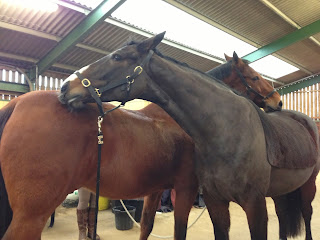
Mutual self grooming time


If you own two horses or more but aren't allowed to turn them out together, be a 'pair' whenever you can;  leading them to and from the field together,  or when in hand walking in the menage as exercise.

Essy and Solar Field Mates for 16 years

Fun

I don't really know if horses like to play with man made horse toys. I should try it before I dismiss it.  Horses will have fun naturally by running and chasing about.  If safe to do so, and allowed by the yard then consider letting them have some 'mooching' time together in the menage regularly in the week.

My two tend to run about and play versus mooch about like two 20 year olds- hence the need for safety factors; leg boots and the yard owners permission!


I have found my horses seem to enjoy some one on one 'human time' simply walking by my side, talking, doing nothing in particular seems to be enjoyable as their ears flick back and forth as if listening intently. 

Parelli seems to be another potential source of fun and way of interacting with our horses which they again seem willing to partner with us in. 

Lead your horse around the yard (let him free if allowed and if safe) - let him explore 'off piste' the non horsey places.  My horses love tack rooms, club houses, and behind garages and stables.  They have a terrific sense of adventure through exploration so indulge in that and play to their sense of smell.

Treats

Go ahead and continue to spoil your horse, show him you love him but do it with a healthy option; replace carrots with Herbs!

Banish carrots and polo's and other human sweets.  We limit how many we give our kids so why would we think they are good for our horses?


Free Will and Rugs

This one is still under 'development'.  What I know is that at the end of the day I can't wait to jump into my 'sweats' /PJ's.  I love to get rid of the physical ties of the day from around my body.

With my horses,  I try to have head collars on my horses as little as possible.  I want them to feel free from ties too.  This goes for rugs too. From April to end of October they are all naked.  Indoors and outdoors. Winter is more challenging:  Grace needs to be clipped as she is in ridden work and gets sweaty which doesn't dry quickly.  Solar is 23 and gets stiff stabled overnight and so she is rugged during the winter.  Essy (king of heat) wears as little as possible in terms of rugs.  He wears a summer sheet only all through the winter overnight, unless it drops to minus 3 or 4 then a thin Polly goes on.

Most of us can't and don't want to turn out horses out for 365 days a year and not see them again as they do in the planes of America. We want to interact, spend time with them, ride and groom them daily. However,  its worth remembering that we do these things at a time of day to suit us.  With a frequency and intensity that we determine.  The horses wishes and mood to tolerate our desires are secondary, most of the time. So small gestures of flexibility (of letting go of the agenda or timeline) on our behalf, can go a long way to showing our horse that he isn't subject to our will ALL THE TIME.

When walking in hand, to or from a field, or to the menage, horses will tell us when they want to go with us or not.  Do we listen?  Can we now stop and wait for them for just a moment or two to show them they have free will (their desires count) - at least for that brief moment in time?

Even if they grab that moment to graze or chew on the menage fence - it's good feedback and data about our horses level of stress or need or inclination at that time.

Snack time on route back to the stable for Solar Sue

Feedback is a gift!  There's even a business book with that title.  Our job as conscientious owners is to solicit our horses feedback plane and simple!

As an exmpal Essy hates being rugged.  Always has.  He  pulls faces, and at times will go to bite you - clear feedback.  Ive leaned to go 'ok, if that's really how you feel, then no rug tonight'.  What's the worst that can happen if he's not rugged? He's indoors at night in the winter.  He may get stiff from lack of movement.  He may drop some weight burning extra calories to stay warm.  Or, maybe neither will occur and his coat will do it's job, keep him warm and all will be fine!

Sometimes we have to have the confidence that our horse really does know better than us, what is in his best interest! When we can, it is quite a pleasant relief!

Barefoot

I would never have imagined taking all 3 of my horses barefoot.  I had every excuse ready at my disposal.  If the time isn't right yet for you then begin with educating yourself, read, go on a 3 day Equine Podiatry course or simply hang out with others who have gone barefoot so you know more.

A good starting point is to get your horse's feet assessed by a podiatrist.  It often costs nothing and will give you some facts about if it is worth considering further for your horse considering his environment, diet, workload etc. 

If and when ready to go naked, start by removing the backs only.  If you do that, I'd give yourself and your horse 12 months before you then consider removing the fronts.  Take your time.  If you've shod your horse for 10, or 20 years, then another 12 months won't be the end of the world. You'll learn so much in the first 12 months of being barefoot that the fronts transition will be much easier.

Support

Don't forget YOU in all this.  Surround yourself by like minded people.  Follow Blogs by people whose point of view interests you.  Be around those who want to do better for their horse and who are trying day by day, step by step.  Share ideas and successes. Be open about failings so others can learn.

Go to conferences that interest you, and network.  Someone may be able to offer you advise and help right now that could help get you moving in the direction you want.


Final thoughts from an Angel!

I know I won't stop reading and questioning the way I care for my horses and my motives for doing things the way I do.  I'll continue to have guilt trips and worries as I go.  I can't pretend that Ive accepted that - I haven't - I do wish I was someone who didn't worry but for now that's not me!  What I do work on and try to improve is the degree to which I beat myself up! 

At times we all need help especially when wrestling demons like guilt, blame or self pity. I do believe and have personal experience to prove it that when we really need help it tends to emerge.  I had one such experience at a conference I attended last summer in Warwickshire. 

Having shed a few public tears of frustration at not being able to keep my horses the way I wanted, one of the other delegates on the table offered me advise, practical tips and lots of encouragement.  Many of those tips are captured above.  She went on to remind me that:


"...if it were not for us wanting to ride and enjoy them, horses could be extinct!  We do always have to compromise –we offer them survival, they offer us work and companionship, but we also have to respect their needs and whilst we cannot offer them the open, treeless, grassy plains of their natural home, we can make domesticity acceptable for them.  We also protect them from predation, seasonal shortages of food, harsh weather, repeated breeding and the other hardships that come with a free life...".


I think her words provide a reminder that no situation is ideal.  Her words do give m a sense of calm every time I read them.  I'm not a bad person for keeping horses.  Nor are you.  Are we perfect? No.  Can we do more?  Yes! If we keep trying to improve our horses lifestyle and work together to build on each other's ideas and have patience with those who try to mock them.

That's got to be the fastest route to getting more help to more horses and ultimately that will make many more human's lives feel like ones well - lived!

I'd like to publicly give my thanks to Jane at Simple Systems for being that Angel in Warwickshire who descended upon that day and into my life when reassurance was very much needed. Thank you Jan!


Tuesday, 31 December 2013

Happy New HORSE Year!

Photo courtesy of Andrew McFarlane at Lead Change


2014 is the year of the Horse!


 I can't think of a more inspiring animal to commemorate!


The spirit of the horse is recognized to be the Chinese people's ethos – making unremitting efforts to improve themselves. It is energetic, bright, warm-hearted, intelligent and able.

I wish these qualities for all of us who chose to be around horses.  May their wisdom lead us to the right place for our own self improvement!


Happy 2014 to our Friends all around the Globe, connecting through this blog, through the voice of Essy and his wishes for all horses....

We are listening to you ALL the time; please listen to us,
We know everything; your thoughts and feelings even when you are not close by.

We  always want to do our best for you,
We are sorry if we don't always live up to those dreams.

We want to be set free - free from a life of over work, from being without our friends, free from pain, from domination and bullying.

 We will be your partner but it has to be in a different way, with respect, 
Respect doesn't mean systems and methods - it means equality.
 
We wish for you to be more 'authentic' and live for now,
 without agenda and gadgets to bare upon us.

We hope that above all that you wont give up on us too soon, or cast us aside.

We hope you will stop taking us away from our mothers too early,
We can see ahead and know the pain and damage it causes.

We believe in our future together,
We hope to see you there; in a field of happiness, honesty and heightened awareness.


Essy, Grace and Solar Sue xxx
 

Saturday, 28 December 2013

Barefoot Gallery - Grace

The Story So Far: Shoes to no shoes - Grace's transformation 


If a picture paints a thousand words and you want to see the 'before and after' shots, scroll down to the bottom of this post.

WARNING!

Transitioning to barefoot entails owner hard work, diligence, patience, positive thinking, a tough mental attitude to keep going, bravery, attention to diet, and lots of time for pad walking - here is the story of Grace's journey to healthy feet and my own emotional roller coaster journey to get there! 

Background:

I bought Grace September 10th 2011, aged 6.  Fresh from the continent she had been shod in front and not behind (allegedly). During the 5 stage vetting my vet had said she didn't have great feet.  I remember feeling a slight twinge of worry (no foot no horse came to mind)  but as everything else about her was perfect, I went ahead and bought her. 

Early Warning Signs:

Over the next four months two things changed:

Firstly a fellow livery and friend at my yard kept bringing up a website she was following all about barefeet and laminitic rescue cases. That site is Rockley Farm Rehab and I highly recommend a read if you are curious. I too became curious.

Secondly Graces' left hind foot (barefoot) began to change in appearance.  It became what is called 'bull nosed or dubbed'.  I had nick named it 'club foot'.  It looked like the toe had been sliced off.  I decided to ask my farrier what was going on.

A conversation with my Farrier...

My farrier explained that it was erosion of the hoof wall caused by working her on the sand and rubber in the menage! 

I was shocked and confused (and worried that it could be a 'me- made' problem) so I asked him to come into the menage to check it out as the cause.  I was hoping when he saw the menage with all the rubber on top that he would change his diagnosis. ( I was beginning to think no more riding!).

He came, but he did not change his mind.   The conversation went as follows:

Farrier  "That's it.  This sand under the rubber is what's causing the problem"
Me       "why is it only affecting one hoof when she clearly uses both hind feet in all her work?"
Farrier  "its obviously the way she moves, she must drag this foot more than the other"
Me        "but I only ride her in the menage four times a week for about half an hour it's not much work to cause that effect, surely?"
Farrier   silent!
Me       "anyway wouldn't this toe dragging  have shown up in the vetting?"
Farrier   "not necessarily.  I see this a lot"

And that's the moment where all us horse owners are supposed to say...

(Owner) : "oh why didn't you say? If it's happening to others then that's ok, I'll leave it at that and take no further responsibility or curiosity in the fact my horses foot is disappearing!" Duh!!!

I walked away feeling that the whole conversation was at best surreal and most definitely suspicious.

I began to wonder if this sheared off toe could be man made by the farrier?  When your farrier is well known, wins competitions for his work all over the world you doubt yourself not him. If it hadn't been for all the reading I had recently started to do on the Rockley website my intuition might never have raised its uneasy head and given me a good mental shaking! 

As it was I was about to go on holiday for two weeks which would buy me some thinking time as to what to do next.  (At this stage it was only her back foot causing me concern but that was about to change too).

Holiday time February 2012

Two weeks provides a lot of thinking time. I decided to take some reading with me and properly immerse myself in this barefoot movement.  I had always considered it to be the action of 'do good, hippy types' who were trying to keep horses on the cheap!  Embarrassing to admit it but that's what I thought.  Maybe you have a similar perception, or worse!

My holiday reading changed that perception irrefutably.  The Books I read and recommend as a starting point include:
  1. Paddock Paradise by Jamie Jackson
  2. Feet First by Nic Barker and Sarah Brathwaite
  3. Making Natural Hoof Care work for you by Pete Ramey

If you prefer to watch videos  - I began with Pete Ramey's DVDs' - it provided hours of education as I watched him rasp and care for a young ex racer in a lot of foot pain and unable to walk.  


How did I feel on holiday as I read my books?

Excited!
Lost!
Guilty!
Horrified!
Motivated!
Stupid at times! For having had so little foot knowledge after 38 years of being around horses.
 
I felt every emotion possible when you realise you are on the brink of discovering a new and better world which simultaneously fills you with horror at 'not knowing all this before now' and for any pain or discomfort you unwittingly caused your horse (directly or indirectly).

I felt resolved to find a better explanation for the sheared off toe but at the same time I felt alone in doing so.

I sensed my days with this farrier were short numbered but I thought it better to have more 'data' to help me decide what to do next.

Two decisions I made:

I  booked the vet to come and X Ray Grace's feet.

I  booked to have Gait Analysis to prove or disprove if she was toe dragging one hind.

The diagnostic results:

The X rays showed flat P3 in all four feet.

The Gait analysis proved she moved normally with no noticeable difference between her two hinds.

The Professionals recommendations:

The Vet reacted to the X Rays by telling me to immediately have her hind feet shod and "all 4 heels jacked up with pads" quote!

The Gait Analysis people recommended keeping her hinds bare for the dubbed toe and walk her extensively in 'sole mate pads' which they said would correct the problem.  They also recommended going barefoot in front.


Great!  So the experts are totally in disagreement and no one can shed any light on the cause of a hind foot that had lost its toe and i'm supposed to know what to do for the best.   No wonder some owners walk away and decide to do nothing.  Hardly surprising. 


If you look at this hoof and think "that looks normal to me" Please realise its NOT! It's neither normal nor healthy!  The foot is lob-sided.  There is flair to the outside.  The squared off toe (dubbed) is abnormal and impairing the foot's function. I have now learned that bull nosing (dubbed toes) is caused by a bulge in the wall NOT wearing of the toe, even if a farrier tells you otherwise.

I see many hind feet looking like this in shod horses, with toes bulging!  It doesn't have to be like this. My 'non horsey' step son thought this foot looked odd.  Often our problem as horsey people is that the more we seen feet that are not right or healthy,  all around us, the more we stop realising it's not how its supposed to be.  It's not right!

Think about it this way - why does the horse's hoof have a Toe at all?  It must have a function just as our toes have a purpose to balance us.  One of the equine's  main functions of the toe is to circulate blood and kinetic energy around the horse's foot. If the toe starts to bulge (like above) that function is impaired.  Pure logic and fact based on the study of the internal functioning of a horses foot.

An argument with my vet!

My vet and I had a very heated exchange about his verdict and advise to shoe all feet and pad up the heels all round.  I remember telling him that I felt to put shoes on all four feet was a "backwards step as she was already naked behind" so why would I put shoes on bare feet? My vet was utterly gobsmacked and told me as much.  He actually used the expression "I don't understand your point of view".

I explained that I was realising Barefoot was a more healthy approach for foot care.  He snapped.  I'll never forget his next words to me, and I want to share them so that others can be ready with a reply should they face the same attitude from their vet...

Vet: "I don't understand your attitude, 90% of horses in this country are shod!"

It might be factually true but does that make it right?  I told him that if 90% of the public were obeiss would that mean I should follow suit too?

I ended that conversation quickly with him telling me he was sending a remedial farrier to re-shoe her!  I felt bullied, trapped and not in charge of my own horse's welfare. I sobbed on and off for most of that weekend!  I had no idea what to do next.  My vet had gone on to scare me half to death warning me that if Grace's heels weren't jacked up with pads to correct the flat P3 that in two years time she would be at liphook vet hospital undergoing  suspensory surgery!

Hence the tears!  I was frightened to death by his assurtions and by my lack of knowledge with which to reply.

I was in a not -so-great place! It's a place I am sure others have or will find themselves in.  Yet I couldn't let go of the barefoot issue.  Something about it made sense.  It resonated with me.  I had to keep going.

This is when the universe or fete kicked in and gave me a hand!  One evening I discovered the writings of K.C. La Pierre.  I sat up till after 2am reading his articles.  It all made sense.  KC is an American.  An ex farrier.  He is intent on finding a better way than hammering nails and metal shoes onto horses feet.  He founded the Institute of Equine Applied Podiatry.  He has trained others to follow his techniques, some in the UK.  I decided to contact one and arrange a visit for an initial assessment of Grace's feet front and back.

This is what she and I saw when we looked at Grace's front feet in March 2012 before her shoes came off.  It should look 'wrong' to you.  The folds, and uneven sole is NOT normal, not healthy and not right.  It looks like a lunar landscape full of craters!


A few weeks later, Grace threw both front shoes in the field.  I decided this was the sign to go ahead and try barefoot.  I phoned Kat and when she arrived this is what faced us with no shoes to hide the truth of her front feet.


I had no idea a horses foot could look this broken and in such poor health.  Shoes mask the truth.  As owners, we must start to look beneath the covers to be more informed about what's there!

The back feet weren't looking too good either...both a couple of stumps and not fitting a 17.1hh warm blood.
The list of problems evident with her feet included but was not limited to:

  • Seedy toe - especially severe in the left fore
  • No wall at the toe - both fronts
  • White line disease - both fronts
  • Severely under run heels both front feet (worst Kat had ever seen)
  • Misshapen frogs without integrity, too much mass and poorly functioning
  • No quarters- missing wall on both front feet
  • No inner and outer wall connectivity - front feet all the way around
  • False sole - front feet (tons of it as foot tried to stabilise itself)
  • Deformed hoof syndrome (dubbed back feet)
  • Even the structure of the hoof horn (tubules) were growing horizontally not vertically weakening the back of both front feet
  • No frog spines on front feet
  • Very poor digital cushion and cartilage - front feet
  • Sole depth poor - front feet
  • No heel purchase - front feet
  • Bars were thin, distorted and laid over with excess growth - front feet
  • Poor periople - fronts
  • Lack of foot balance - front and hinds
  • Flare - quarters and toe - front feet
  • Front hooves - splayed
  • Crushed heels - front feet
  • Stress rings - front feet 
  • Walls in poor health
  • Feet x 4 all out of proportion in size - fronts too big and hinds too small
 8 Weeks later (by June 7th) things were looking better already even on her worst feet...


March 2013 - almost 12 months on.... the worst feet are looking better and better!


November 2013, back foot is beautiful!  Worst front foot has last of the seedy toe and a healthy hoof and foot!


With four fab looking feet, the work isn't done!  Daily her feet her cleaned with a wire brush.  Once weekly I treat her feet with a paste that is great for conditioning (or treating thrush) called Field Paste.  Twice a week I spray her feet with my home made solution of Essential oils that fight infection and bacteria as a preventative measure. Of course exercise and movement is critical.  Her diet is stripped down to grass based pellets only, minimum sugars, limited carrots and absolutely NO MOLASSES.

If I hadn't seen the transformation with my own eyes, it would be hard to believe her feet today belong to the same horse.   I know her feet so well now that any small change in them gives me feedback about diet, grazing, environment and lifestyle.  It's a great tool to have and a very unexpected benefit from the process.

Above everything I have learned (and continue to read and learn about) the most impactful thought I have is 'how lame would she be by now if I hadn't helped her feet back to health?'  

When I bought Grace she wouldn't or couldn't lift her hind feet to pick them out.  It was a nightmare trying to get her to lift them.  Two weeks after removing her front shoes I noticed she started to lift them.  Today, she raises them up hock height.  I now believe she couldn't lift them 2 years ago as to do so caused her to weight shift onto her fronts.  Given their condition this must have been painful for her. There's always an explanation for things our horses do, or don't do.  Half the time we just don't know where to look.

To think her feet were this broken by the age of 6, but how quickly I saw them transform.  So much so it gave me confidence to remove the shoes from my Thoroughbreds aged 21 and 22 after over 18 years of them wearing shoes all year round! 

Gallery No 2 to follow will share those photos!