Showing posts with label Parelli. Show all posts

Wednesday, 5 August 2015

When something truely Amazing happens..

I started this blog with a title of ....

I was lost and now I am found


As I typed the title it felt familiar so I googled it and found that its the lyric from a song but not any old song - it's from Amazing Grace!

This post is about Grace! "How amazing" I said out loud.  Then laughed - amazing as in amazing Grace!  Oh stop!

Today, Grace and I had a Parelli session with Vicky Manser - our first in over a year.  How time flies!

We began with me summarising the events of the last year, Grace's feral behaviour and massive separation anxiety that led me to stop riding, lunging, doing Parelli or anything with her, finding her unsafe to be around.  That's it in a nutshell.  I described feeling like I'd lost my horse, and the aim of today was to re-start the journey to find her again.

It's not often in life that we achieve our goals, its even more rare to do so exactly when you want it or need it.  But today, that goal of finding Grace happened!  In 90 minutes Grace and I were home....together!


I know that sometimes we have to get lost, stray, deviate off course, in order to discover new paths, to return to something better  - and today has been a massive reminder of the value of that.  

Today I remembered and learned all at the same time ... 

  • Not to dwell on the past, or the feeling of having wasted (lost) a year of progress. 

The past is the past and nothing more.  
Today was better than yesterday and that's a good place to be!

  • To recognise the difference between observing a horse and listening to them.  I've been watching Grace but not listening to her.  As the song say:-

Amazing grace! How sweet the sound
That saved a wretch like me!
I once was lost, but now am found;
Was blind, but now I see.
  • To get connection work with the very moment of distraction (the object of my frustration) - that's my cue to change direction, pace, and help Grace to focus back inside the menage and back on me.

  •  If fear is the focus of my thoughts then fear is all I'll feel.  My head and heart needs to chose to remember trust and joy as equal opposites.

’Twas grace that taught my heart to fear;
And grace my fears relieved;
How precious did that grace appear
The hour I first believed.

  • When I'm in 'blame' mode I'm not thinking!  If I'm not taking responsibility then why should Grace?


It took less than an hour of walking around the menage, mirroring pace and energy, working with distraction, to have a calm, relaxed Grace - the old Grace, back!  Soft eyes, droopy lower lip, licking and chewing.  Everything that dreams are made of when all you want is to just "be at one with your horse". 
Grace August 5th 2015
So many highlights from today!
Having Grace lick my hands, gently, with such softness - a nice change from grabbing at me and biting.
Seeing Grace think, process, reflect and soften with the brain work, stimulation, and presumably enjoyment of some shared leadership for a change! 
Listening to Grace sigh with relaxation not boredom. 
Finding myself having a thought and saying out loud to Vicky "I don't know if this is my thought or Grace's thought but I think "I've just come home"   - at which point Grace stepped forward with a lowered head and neck and literally nestled into my body and stayed there.   Feedback that it was her idea not mine and I think i just had my first experience of sensing a horses's thoughts!
 
 
Through many dangers, toils and snares,
I have already come
’Tis grace hath brought me safe thus far,
And grace will lead me home.

Realising that both she and I had been lost was the biggest 'ah ha' of the day.  How can I expect her to return if im not there myself?   How can I expect her to go (emotionally speaking) to any place where I can't get to myself?  The logic of it should hit us hard.  If logic isn't enough, I hope everyone reading this blog has an experience similar to mine today.  

Parelli has been a foundation.  A set of bricks that were in place, then got ignored but sit there still strong and sure.  It is NOT about doing the exercises and using the techniques.  It IS about listening to the horse infront of you and selecting tools to suit the needs of that moment.  
Today I have a lot to be grateful for...
  • Thank goodness Grace and I got lost.

  • Thank goodness we are found again (or well on our way at least)!


Monday, 21 April 2014

Clinging On!

Why do people follow the word or practice of others, with the fervor of a religious calling?


In this post the question posed is for us 'horsey folk' to consider our devotion to any horse training techniques, be that "natural" or 'other.'

It is irrelevant to this post what any individual training technique is, or who the teacher is.  I am not about to rain on someone's parade by condemning any method or style of horsemanship.


I simply want to pose questions around what lies beneath our own behaviour when we cling to methods, heroes or gadgets, especially when those methods get challenged and we fight hard NOT to listen, clinging to it, as if it provides the only truth!

What might surprise us is that often our 'followership' of a method or technique runs much deeper than simply buying into the logic behind it, or the attraction of the results it creates.  Let's explore...
 
We all have the potential to house a strong desire to remain who we are (our unique identity), even if that causes us problems such as addictions, religious fanaticism, victim mindset, or loser. Siblings fight to differentiate themselves, children fight to 'be seen' by their parents and spouses fight 'not to be changed' by t'other!

We want to be ourselves and remain true to that! (Or, at least be true to the person we think we are and see as ourselves).


Who we are and what we believe in, originates from our past - our early childhood years.  However, we've forgotten to remember that almost nothing that was going on in our lives and environment back then, still applies today!  Most things have dramatically changed.  Many of the people who were early 'influencers' on our thinking and behaviour aren't around anymore.

Most of us don't re-visit our childhood born beliefs to evaluate if they are still useful today. 

Why not?  What are we afraid of?

First of all, knowing who we are provides certainty; we know our role and our place in life, society our family and home. We also know what to do in certain situations and we become predictable to others (which others like).  Once we believe something (for example 'nice girls don't boast' or 'hard work brings just rewards'),  such beliefs become like a backbone supporting us, which makes us very resistant to change them.


Additionally, as social animals our identity and beliefs help us to take our place in the herd. Without it, we cannot relate or bond. Social exclusion seems to be worse for many of us, than any of the complaints resulting from a problematic identity and belief system - including addictions, crime, or a victim mentality. 

In other words,  on a subconscious level as long as we are someone and belong to a social system or group, we can live on, however problematic. (Also explains why on Face Book someone wanted to know "who is Debbie Percy" as if I had to be a 'somebody' to voice my questions about the legitimacy of the Horseman's Calling Event).

Joining in with and belonging to horse groups and specific training methods can lead us to attend Tours, Demos, Events and Rallys where other like-minded disciples can hang out together... 

After all, there's safety in numbers and we can't all be wrong! Right?

It can also lead us to rise up, speak out and defend such a group against any criticism (valid or otherwise) but why? Why bother? Why get angry? Why spend time blogging, posting etc?

I think it has to be explained simply.  Amongst all our complex beliefs, personality factors and motives, a lot of the time humans (horsey or otherwise) have a need to be right.  We hate it when we are wrong, at home or work.  It's as if being right somehow validates who we are and in turn, our very existence.

If we stopped to think it through, I am sure we would have a quick private giggle at our own folly!  I don't know about you, but I'd rather be happy than right! I'd rather have a unique, real, connection with my horses than simply copy what someone else does!


So exactly what is the problem in defending something you believe in?  

Nothing on the face of it, except that history shows us it's danger when taken to its extreme and leads to violence, wars, civil unrest, oppression or revolution and cruelty to ones own kind.

Extremes occur when we lack balance. Balance often comes from perspective - a change of; a difference in; or a fresh one!

If we are to develop our awareness as humans to really connect with horses, then growth comes when we embrace our problems as agents for our growth.

So, instead of being furious about someone's criticisms of something you follow, why not be curious? Why not step back and think about what they see (even if we don't see it like that)?  Why not see it from another view point and THEN decide to poo poo it or not?  My mum always used to say...

"pass your exams first, then you can criticize the exam system"

Why should we step back and think before we attack or defend?

No one has to! It's always our choice.  But, if we continue to attempt to protect ourselves from the problem of others opinions not agreeing with our own, it can end up running your life.  Both the problem, and the pattern!  I have seen this in my own life but it took 35 years before I noticed!

Until I opened my eyes, I had been full time employed in the pursuit of proving my independence and my disdain for commitment or marriage -regardless of the views of others close to me.  I had my career and I pursued that with conviction - I had a ladder to climb!

I climbed that ladder but soon fell out of love with the view! Suddenly the very thing I had fought tooth and nail to defend, held no value and seemed rather silly in the grand scheme of life!


My fear of not being good enough, others knowing more than me, making bad decisions or simply getting it all 'wrong' had run my life and limited what I could see from the windows of my mind.

It's actually quite exhausting having to think about yourself all the time!  

The constant inner chitter chatter that rises up to make us attack another's view, or follow someone else without checking if it's still relevant, is usually born from fear.  An example of that fear might be anxiety around trust.  So, once we place our trust in Monty, Pat Parelli, Mark Rashid, Carolyn Resnick or Debbie Percy - we don't want to be exposed and have to go through the process of trusting, all over again.

We want to be right!  We want to be safe!  We need a Guarantee!

I soon realised that every time I was trying to make myself feel better (or right) it meant I wasn't ok inside!  When our psyche needs protecting,  we often seek false sanctuary with others, in a blessed place (aka the Demo or Tour).  Of course it provides no safety, the criticisms exist outside that space and are waiting for us on our return. 

Yet we don't have to devout our life to satisfying our psyche (inner chitter chatter)! A naturally healthy body and mind is one that just does what it's supposed to do while we go about our business.  The mind is supposed to come up with thoughts.  That includes questions.  It is intended to work with imagination and analysis.  Not just one instead of the other!  It is a computer, a tool. It is NOT us!


Our mind can be used to ponder great thoughts, solve scientific problems and serve humanity.  The good news is that there is no monopoly on how we can serve humanity or who knows best!  Our brains are capable of building on what others have created or invented before us, and taking that to the next level.  We are constantly evolving and this includes, our methods of training and how to "be" with our horses.

When we resist 'new', 'different' we resist this natural evolution.  It makes no sense to fear it. It's perfectly natural!

I believe that most of us in the horse world can live together side by side even when our minds fire off in different directions.  It is what's driving our hearts that unites us.  Perhaps it is time to start listening to our hearts before we start talking or attacking.  I know when I wrote my blog about the Horseman Calling Competition it was in my heart that felt I had to. I just used my head and brain to express what my heart was sensing! I tried to understand the goals, intention and process behind the event in order to know if it was calling me to attend it.

We may still not agree with one another when we listen to our hearts before our heads, but we might realise it's not worth fighting over, without first seeking to understand it further.  For me (with the Horseman Calling Event), I could not balance their focus on competition, tests and speed to back a two year old horse along side their mission of  'doing good for the horse'.  The latter resonated with my heart the former did not!  

Had I had more notice of the event happening I would have made contact with the organizers to ask some questions to deepen my understanding of the event, beyond what was on the website.  I am glad however that I had only the website to go on, as it helped me really think about what I was reading.  To improve our ability to read, listen, speak and actually notice what is being said (or not said) has to be a good thing if we are to wake up and take responsibility for what we do, who we join with and support.

Stephen Cover encourages in his Business Management books to ...

"seek first to understand; before being understood"

For over a decade I fought and resisted even looking into the work of Pat and Linda Parelli, believing it to be circus tricks and nothing more.  Two years ago that changed for me.  I have now worked with their approach, used it, found it to have value and limitations and consequences.  In summary I believe that as an approach:

- it has many positive aspects and useful learning to be shared that is of help and value for humans and horses 

- it is not however a panacea for all ills!  It is not THE way, nor the ONLY way, nor the RIGHT way.

It is simply ONE way!


The more 'enlightened' Parelli trainers know this.  They would agree.  They encourage owners to merge their approach with other ways.  To use the best from different methods and dump the rest!  That feels healthy to me.

I want to be respected by a trainer as someone with my own heart and head.  I am not a sheep and don't expect to be cast aside for not following a trainer's every whim and suggestion.  Nor do I expect to absorb what a trainer tells me as if it is gospel, because it just might not be!

When Essy spoke of Humans needing to become much more aware I wonder if he was trying to encourage us to go outside, go beyond the walls and windows of our mind to see what exists in the world beyond! Our heart can often help us in that endeavour.

I have had my best 'breakthrough' moments to escape my old limiting patterns when I have decided to lower the draw bridge and walls of my fortress. There's actually no need to continue to support, maintain or defend my fortress. My let go moments were often leaps of faith, where I followed my heart not by brain! (Just ask my husband)!!!


If you feel that more and more you are being pushed beyond your comfort zone (fortress walls) - celebrate! Every time something comes into your awareness that rocks your foundations of what you thought was right or true - be thankful!

If our horses are to be our Guides on our journey of 'waking up' we will experience these feelings more and more.  Every time we are tested, we have an opportunity to grow! That has to be 'for the good of our horses'.

Back to my question of do we want to be happy or right?  Life is going to change.  New things will happen and new opinions will appear.  The question is are we willing to be happy regardless of what happens?

Our life purpose is to enjoy life and learn from the experience.  To be happy we have to let go of melodrama.  After all, to keep things in perspective we are but a dot sitting on a planet that is floating in an empty space in a universe that goes on forever!

Does it really affect you, what I, or anyone else says unless you decide to let it?


If we are going to be here, we may as well be happy and accepting of others and their points of view. 

If we make our happiness conditional upon what others say and do, we are in real trouble! 

If we suddenly found out our hero or guru was a fraud where would that leave us?  Our core would be rocked. This is dangerous.  An antidote relys on us deliberately paying close attention to the work of gurus or experts, especially amongst any claims of the Messiah amidst us, because it matters to do so!  

With gurus and ourselves for that matter, it's not what we are doing or supporting, but how much of us is doing it!  It needs to be our whole self: body, mind, heart and soul, being present, awake, aware and accepting.

Sometimes when we discover we had been following a fraud its because they don't walk their talk 24 x 7, and we haven't being paying attention!  The clues are usually there if we are open minded enough to notice!

Putting people up on a pedestal is a risky business; there's typically one way for them to go! Being open to someone else's different perspective can help us avoid looking like a right burk later on if we've blindly following something/someone like an idol, only to find out their full transparency left something to be desired.

It is scarcity that makes things valuable or precious.  

Natural horse ways are still practiced in the minority by horse people,  but anyone calling for us to be even more in tune with the meaning of 'natural' (as we know it thus far) is a friend not a foe!  Even if their perspective seems at odds with ours or sits uncomfortably with us.  Think of Monty Roberts and how long it took for him to be accepted and not ridiculed or condemned!  

As I believe horse people share a common heart felt desire to help horses, maybe future Natural Horse Gatherings will sound more like...

Hearts calling, not Horseman calling! 

Meanwhile, why not get the most out of this life and be able to give back to our horses the best we can, from a range of options out there, following our heart, respecting our head, but not blinded by loyalty or fear!

Besides being right all the time, must be quite boring after a while?!


Monday, 13 January 2014

My Horse is a parcelmouth!

"How many languages do you speak?"


I first asked the question 'How do horses know what we want and mean them to do?' when I was 14 and taking riding lessons.  It amazed me then, and still today, how a horse understood that when I slightly moved one of my legs back a bit the horse knew it meant to canter. It blew my mind away.

The awe I felt then (and still remember feeling 35 years on) hasn't died with age, years or experience.  Thank goodness!

This weekend a friend and I spent time lunging our respective horses and coaching ourselves through it. I was explaining how Grace understands two different "languages on the lunge".  First is the more 'traditional BHS language of whip, triangle position and tone of voice'.  The second language is the Parelli language of 'chi, no voice, levels of asking and lots of hind quarter yields', (as examples). 


A 'parcelmouth' speaks snake!

Having decided to use the BHS approach with Grace on Sunday, the significance of having a choice of which language to use when working with her, and what I was therefore saying, was clear: Grace is multi-lingual! 

To me it is pretty impressive that horses can retain and recognise two different languages, when used separately or in combination,  and not appear to get confused.  As a contrast I used to speak fluent French and Spanish in my teens and twenties.  Nowadays, I get my tongue tied and end up saying things that I don't even think are legitimate words, and can't remember if they're French or Spanish!  (To think my mum had her heart set on my being a tri-lingual interpreter in Brussels for a living)! 

What's even more great about the language of lunging is that you are only limited by your imagination.

I shared with my friend how my horses and I have been developing our fluency levels in both languages:

Step 1 : Was to find the voice commands and tone of voice I would use consistently, for signalling faster, slower etc

Step 2: Was to coordinate voice and whip so that the horses will respond off either

Step 3: Was to rely less on voice and whip and to substitute both with my body language and how to use both it and the space between me and the horse with differing effects

Step 4: Was to introduce breath based commands - taking a few lessons from Jenny Rolfe and others who connect with their horse through breath control - inhalations and exhalations

This is the Step where Grace and I have currently reached.

 Step 5:  Will be to move from breath commands to intention.  Meaning I want to start changing my horses gait by thinking it - nothing more! No voice, body, whip, back up!  To just send out the intention of walk, trot, halt etc.

Step 6:  Will be..... I don't know yet!  When we get to step 5 maybe step 6 will emerge..... that's what I mean by we are limited only by our imagination.

As most of us Harry Potter fans will know - being able to speak parseltongue makes you a parcelmouth which although normally entails lots of hissing like sounds, absent from my horses most of the time thank goodness, working with them does feel a kin to magic and wizardry!

I'm not sure if my carrot stick or lunge whip is quite as potent as Hermione's wand but I am convinced that horses are bright, quick to learn and fluent translators.  All we have to do is communicate clearly, be it in one or two tongues and our horse will compute and conform. 

It has me spell bound every time!


“Imagination is more important than knowledge. For knowledge is limited to all we now know and understand, while imagination embraces the entire world, and all there ever will be to know and understand.”


- Albert Einstein


Thursday, 2 January 2014

Envy or Inspiration?

Is modern day horsecare easy or hard? 

There's good news and bad news in broadening your horizons to do better!  


Over the last few years I have had many moments wishing I could go backwards, back to a time where I knew less!  The saying 'ignorance is bliss' has really resonated.

I haven't chosen to remain ignorant - not when it comes to trying to do the best for my horses.  However, 'further education' has come at a price as my mood has swung from inspiration to envy.

Here's why...


Imagine that today you learnt that over 75% of your 'lifestyle' was causing you stress; impairing your immune system, messing with your mind, and depleting you emotionally.  That it is robbing you of your very nature - the essence of who you are, your genetics and your rightful purpose on this planet.   Worse still you aren't in control of any of the influences upon your lifestyle - you aren't living YOUR life at all.

Heavy stuff!

How would you react? 


Be overcome with fear, panic, dread and a sense of hopelessness at it all being so wrong? Or, be filled with desire to ACT NOW and make some changes?

How long could you keep going without change - surviving only by suppressing and denying your new found knowledge - after all most people around you are living the same way so it can't be too bad! Right? 

Conversley if you chose to act and change, where would you start?  Where would your support network come from as you'd be going it alone?

Of course I've had to teach myself that there is a middle road. Its about figuring out what we CAN change, and what we can't.  What we can do NOW and what we have to plan to do or work towards over time.

Back to good horse care...


It doesn't matter how many books, articles or blogs I read about caring for our horses, I am still hit in the gut with a hammer when I read about what horses need and realise I'm still falling short.

Here's a simple short summary of what a horse needs:

  • Horses need to be out in the fresh air
  • Horses need to be moving 24 x 7 (able to roam between 8-20 miles a day)
  • Horses need to eat at ground level ALWAYS
  • Horses need a diet free of sugars (other than those naturally occurring in grass)
  • Horses don't need Molasses (at all, or carrots etc)
  • Horses don't need metal shoes
  • Horses need companionship of, and physical contact with, other horses
  • Horses need access to herbs, berries, bark, and different grasses to select from as needed
  • Horses need free will
  • Horses need to be able to have fun with other horses
  • Horses don't need to be clean and mud free!
An absence of any of the above starts our horse on the downwards spiral towards stress.

I read books about people who have gone to extraordinary lengths to deliver the above for their horses.  Every time I do, I am inspired by their courage, determination and love - followed quickly by a deep slump into guilt for not having done so yet, for my own horses.

It's easy to find yourself in a pity party looking out from the corner through green stained tears.  Envy dripping from our lips as we utter weak defences for not doing more for our horses, such as ...

 'its ok for them they have their own land and can do with it what they want'

'in America you can find big plots of land dirt cheap, but not here in the UK and especially not in Berkshire'

'at least they did it as husband and wife; and had each others support'

'she was so lucky that her husband and kids were happy to up sticks and move to the country'

'its easy to take risks if your husbands a vet'

'well if you don't have to work full time and travel for your job of course you can build a tight bond with your horse'


Etc. Etc.


What started out as inspiration can change to envy and resentment.  If left untamed these feelings can build into reasons for not even trying! Lamentable in its extreme.

The truth is we all have challenges in moving towards our goals whoever we are, whatever our starting point. Books don't always reveal the whole story and things can often sound idyllic in a book - to inspire us - that's the point!

In our own desires to live our dreams or improve our lifestyle we know that moderation is our best friend.  We do what we can, and keep looking for opportunities to get closer to what we desire. When changing our own life or that of our horses I recommend a step by step approach.  Below are some tips of the things I have introduced gradually and successfully, so far.

Ideas to get as close as we can to offering our horses a less stressful lifestyle:


Diet

Diet is in our control.  We are the ones who decide what and when our horses will eat.  There are a couple of simple things we can do to help our horses have a stress free diet:

Feed little and often (just like humans).  Avoid large feeds as the small intestine is not developed to cope with large intakes of food. 

Check all feeds for molasses and if present, gradually eliminate it from the diet. Molasses in the diet will stress the horses organs such as the kidneys and liver.

Phone your feed supplier and find out exactly what is in their feeds.  What oils?  Many will not mention oils but will include them.  Find out if there are any GM products?  Can the supplier guarantee their products are GM free. If not!  Don't buy them, keep shopping! 


Grazing


Horses are grazers, so anything we can do during stabled time to re-create the grazing habit will enhance their lives.  

They wander around, picking at food as they go.  Putting all their food in one place does not encourage them to move from one eating spot to another, so even some thing as simple as dividing the night hay into two lots and placing them in opposite parts of the stable will enable them to “graze” and make decisions about where to eat.  

When grazing, they have to bite everything off with their front teeth before they can chew it, but in the stable, they don’t need to do this. I feed my horses LucieBrix from Simple Systems which are foods that they do need to bite and they may enjoy a good gnaw on (one or two  a day), to replace the same amount of hay.  

If you are not familiar with these, they are 1 kg blocks of compressed lucerne chop or grass chop, offered dry and whole, ideally at floor level.  
Lucie Brix

A high fibre feed such as LucieFibre Cubes in a feeding ball will also increase eating time and provide a diversion.  

Ensure enough forage is provided so that your horse is not without some thing to eat for more than 2 hours.  For good health horses need to eat 2.5% of their body weight in dry matter per day.  Whilst grazing is hard to quantify, if they are out for, say, 1/3 of the time, then assume that 1/3 of their requirement is met from grazing and the rest must be supplied in the stable. 

Last year I spent time on the phone with Equine Behaviourist Justine Harrison discussing pasture management ideas and how to combat boredom or loneliness.  She suggested hiding food, herbs, bark and branches under safe objects in the field e.g. Tyres.

Roaming


Horses are migratory and love to hack out for this reason especially in a group.  Try to get out on a hack with friends whenever you can.  If it is safe to do so, as you have more than one horse, you could even have a go at riding and leading.

Boxing up to a new place to hack will be enjoyed by your horse as much as the rider!  On longer hacks, stop where safe for your horses to graze for a few minutes every hour to 1.5 hours, as it is unnatural for horse to go more than 2 hours without eating and after this will no doubt feel as hungry and as tetchy as we do if we have not eaten for about 6 hours.

A fellow blogger and horse lover Issy Clarke lets her horses 'snack as they go' and documents her personal journey of learning with her horses on her blog: The Spoken Horse.

Always travel with hay/lage and feed your horse when you arrive and before you re-load afterwards, providing you stick with forage for example the Simple System Feeds – do not ride off any grain based feed!

Fresh Air


In a natural (wild) environment horses have plenty of fresh air and distant views and feel safer with space around them.  Always leave stable/ barn top doors open and if at all necessary and possible  provide additional views by cutting a false “top door” into the back or side of the box.

Wood

If your horse is in a manicured paddock with no trees, bushes or hedge row - dont' accept it and do nothing.  Get your gardening gloves on, and go out to collect twigs, bark, branches (avoid oak) and place them in his paddock and/ or stable to chew on at lib. (See Grace munching on bark below)


Herbs

We don't need to blame the land owner for not planting herbs or allowing them to grow.  We can substitute them very easily.   Offer them daily or put them out in the field/stable in bowls.

A variety of naturally growing herbs are affordable and stocked by tack shops to make it easy to buy.  Herbs such as nettles, peppermint, rosehips, chamomile flowers.  Experiment with the seasons and notice which ones your horse is drawn to each season and make a note for next year.

If you have time and the interest collect cleavers, nettles and dandelions each season, dry them if needed and then offer them to your horses at no cost and lots of pleasure!


Company


Horses are sociable and depend on their pals to help look out for predators.  Provide some means of contact if your horse is in a stable without the ability to hang over the door and see a neighbour.


Grace with bars in both side walls and rear window

Bars between stables are great; grills (like the ones sometimes used over the stable door) set in to adjoining walls are just as good.  I have even seen just one brick removed from a brick wall between stables which enabled adjacent horses to blow at each other.  

Stable mirrors are also good as the horse will be convinced by his own reflection that he has company.  Do not place them near the feed bowl as they may resent such close attention when they are eating!

If you keep your horse on a yard offering only individual turnout to avoid injuries, then make sure your horse can see, and 'touch' another horse over a safe fence.  Alternatively check with other owners if they are happy for your horses to be given 'mutual self grooming time' with the owners present holding them both if needed.
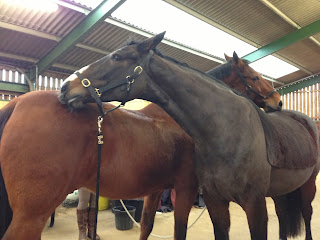
Mutual self grooming time


If you own two horses or more but aren't allowed to turn them out together, be a 'pair' whenever you can;  leading them to and from the field together,  or when in hand walking in the menage as exercise.

Essy and Solar Field Mates for 16 years

Fun

I don't really know if horses like to play with man made horse toys. I should try it before I dismiss it.  Horses will have fun naturally by running and chasing about.  If safe to do so, and allowed by the yard then consider letting them have some 'mooching' time together in the menage regularly in the week.

My two tend to run about and play versus mooch about like two 20 year olds- hence the need for safety factors; leg boots and the yard owners permission!


I have found my horses seem to enjoy some one on one 'human time' simply walking by my side, talking, doing nothing in particular seems to be enjoyable as their ears flick back and forth as if listening intently. 

Parelli seems to be another potential source of fun and way of interacting with our horses which they again seem willing to partner with us in. 

Lead your horse around the yard (let him free if allowed and if safe) - let him explore 'off piste' the non horsey places.  My horses love tack rooms, club houses, and behind garages and stables.  They have a terrific sense of adventure through exploration so indulge in that and play to their sense of smell.

Treats

Go ahead and continue to spoil your horse, show him you love him but do it with a healthy option; replace carrots with Herbs!

Banish carrots and polo's and other human sweets.  We limit how many we give our kids so why would we think they are good for our horses?


Free Will and Rugs

This one is still under 'development'.  What I know is that at the end of the day I can't wait to jump into my 'sweats' /PJ's.  I love to get rid of the physical ties of the day from around my body.

With my horses,  I try to have head collars on my horses as little as possible.  I want them to feel free from ties too.  This goes for rugs too. From April to end of October they are all naked.  Indoors and outdoors. Winter is more challenging:  Grace needs to be clipped as she is in ridden work and gets sweaty which doesn't dry quickly.  Solar is 23 and gets stiff stabled overnight and so she is rugged during the winter.  Essy (king of heat) wears as little as possible in terms of rugs.  He wears a summer sheet only all through the winter overnight, unless it drops to minus 3 or 4 then a thin Polly goes on.

Most of us can't and don't want to turn out horses out for 365 days a year and not see them again as they do in the planes of America. We want to interact, spend time with them, ride and groom them daily. However,  its worth remembering that we do these things at a time of day to suit us.  With a frequency and intensity that we determine.  The horses wishes and mood to tolerate our desires are secondary, most of the time. So small gestures of flexibility (of letting go of the agenda or timeline) on our behalf, can go a long way to showing our horse that he isn't subject to our will ALL THE TIME.

When walking in hand, to or from a field, or to the menage, horses will tell us when they want to go with us or not.  Do we listen?  Can we now stop and wait for them for just a moment or two to show them they have free will (their desires count) - at least for that brief moment in time?

Even if they grab that moment to graze or chew on the menage fence - it's good feedback and data about our horses level of stress or need or inclination at that time.

Snack time on route back to the stable for Solar Sue

Feedback is a gift!  There's even a business book with that title.  Our job as conscientious owners is to solicit our horses feedback plane and simple!

As an exmpal Essy hates being rugged.  Always has.  He  pulls faces, and at times will go to bite you - clear feedback.  Ive leaned to go 'ok, if that's really how you feel, then no rug tonight'.  What's the worst that can happen if he's not rugged? He's indoors at night in the winter.  He may get stiff from lack of movement.  He may drop some weight burning extra calories to stay warm.  Or, maybe neither will occur and his coat will do it's job, keep him warm and all will be fine!

Sometimes we have to have the confidence that our horse really does know better than us, what is in his best interest! When we can, it is quite a pleasant relief!

Barefoot

I would never have imagined taking all 3 of my horses barefoot.  I had every excuse ready at my disposal.  If the time isn't right yet for you then begin with educating yourself, read, go on a 3 day Equine Podiatry course or simply hang out with others who have gone barefoot so you know more.

A good starting point is to get your horse's feet assessed by a podiatrist.  It often costs nothing and will give you some facts about if it is worth considering further for your horse considering his environment, diet, workload etc. 

If and when ready to go naked, start by removing the backs only.  If you do that, I'd give yourself and your horse 12 months before you then consider removing the fronts.  Take your time.  If you've shod your horse for 10, or 20 years, then another 12 months won't be the end of the world. You'll learn so much in the first 12 months of being barefoot that the fronts transition will be much easier.

Support

Don't forget YOU in all this.  Surround yourself by like minded people.  Follow Blogs by people whose point of view interests you.  Be around those who want to do better for their horse and who are trying day by day, step by step.  Share ideas and successes. Be open about failings so others can learn.

Go to conferences that interest you, and network.  Someone may be able to offer you advise and help right now that could help get you moving in the direction you want.


Final thoughts from an Angel!

I know I won't stop reading and questioning the way I care for my horses and my motives for doing things the way I do.  I'll continue to have guilt trips and worries as I go.  I can't pretend that Ive accepted that - I haven't - I do wish I was someone who didn't worry but for now that's not me!  What I do work on and try to improve is the degree to which I beat myself up! 

At times we all need help especially when wrestling demons like guilt, blame or self pity. I do believe and have personal experience to prove it that when we really need help it tends to emerge.  I had one such experience at a conference I attended last summer in Warwickshire. 

Having shed a few public tears of frustration at not being able to keep my horses the way I wanted, one of the other delegates on the table offered me advise, practical tips and lots of encouragement.  Many of those tips are captured above.  She went on to remind me that:


"...if it were not for us wanting to ride and enjoy them, horses could be extinct!  We do always have to compromise –we offer them survival, they offer us work and companionship, but we also have to respect their needs and whilst we cannot offer them the open, treeless, grassy plains of their natural home, we can make domesticity acceptable for them.  We also protect them from predation, seasonal shortages of food, harsh weather, repeated breeding and the other hardships that come with a free life...".


I think her words provide a reminder that no situation is ideal.  Her words do give m a sense of calm every time I read them.  I'm not a bad person for keeping horses.  Nor are you.  Are we perfect? No.  Can we do more?  Yes! If we keep trying to improve our horses lifestyle and work together to build on each other's ideas and have patience with those who try to mock them.

That's got to be the fastest route to getting more help to more horses and ultimately that will make many more human's lives feel like ones well - lived!

I'd like to publicly give my thanks to Jane at Simple Systems for being that Angel in Warwickshire who descended upon that day and into my life when reassurance was very much needed. Thank you Jan!


Friday, 18 October 2013

Super Nanny To The Rescue...

Does Killing with Kindness work?


My recent homework was to watch more TV- specifically Super Nanny!

I'm beginning to see why... we can learn important lessons from her; the "master" of setting boundaries, keeping a check on 'love',  and reading the energy levels of others! She also knows the value of having a plan B!  Super Nanny is always the leader!


Translating super nanny techniques to our horses can work in many different settings.

One of my first 'nanny moments' with Grace was shortly after we began to learn Parelli.  In the stable with her, it took over 35 requests in the same session, of me asking her to stay behind me in the box, and not keep running forwards over me - before she said 'oh ok'!

If ever a horse has taught me to 'mean what I say and say what I mean' its Grace!

A big moving, forward thinking yet introverted horse like Grace often finds it hard to knuckle down to work for example on the lunge, preferring to do several high speed rounds of handstands and cartwheels first -  all of her own making!  A master of distraction!

In Super Nanny when the kids are "hyper" like Grace, super nanny recognises that and changes her plan accordingly.  So, if homework has to be done she'll take them to the park to have a blow off first, before sitting them down for studies. With our horses we have to decide if its best to let them do their antics for a few minutes to burn off energy or not.  I must decide if asking any of my horses to lunge in trot but quietly today is in step with what is the right thing for them given their mood and their energy level.

When mounted, on a lunge, or long line our horses should be willing and able to stay on their circle or line, take responsibility for their feet (and where they place them) and maintain the gait we request until asked to change it.  I love this principle as it helps remind me of our respective responsibilities!

I like the partnering element that underpins the principle: that we the rider/trainer can't do everything and be responsible for everything - let's face it, it's challenging enough some days such as at competitions, just remembering our test and getting past the flowers, flags and judges box!


Here are my top 5 'take aways' from translating Super Nanny skills to horsemanship!

1. Make it easy for your horse to do the right thing!
2. Be clear in your communication  ALWAYS not just some of the time!
3. Establish boundaries (and keep to them)!
4. Praise the result you want (when offered or achieved)
5. Realise quickly that every interaction is a training and learning moment for our horse 
(whether we intend it to be so or not)!


Is it bad to love a horse too much...?

... only if it creates a monster child in the process! There's nothing more heart warming than seeing a strong human - horse bond, where the human loves their horse to 'beyond and back'.  Sadly too often these can be the same relationships that lack mutual respect, honesty and true partnering. 

I've seen more owners get pushed about and walked all over (literally) by 'over loved' horses because there have been no boundaries set and maintained.  Horses are larger and heavier than us!  They understand space and body language - it's their native tongue!  Therefore it isn't unreasonable to expect them to respect our space and NOT RUN US OVER if we establish our space in the first place.  It works a little bit like the 'naughty step' in Super Nanny!


Where most parents seem to go wrong on Super Nanny is that they DON'T stick to the rules and regime she teaches them.  As soon as they waiver the child's bad behaviour returns.  I know from experience that with horses if we show them (or allow the creation of) a gap - they'll dart through it.  Our job as owner, rider, trainer is to pre-empt actual or metaphorical gaps and close them before the horse catches sight!

Besides a lack of boundary management, loving owners can fall short of doing the right thing for their loved one by getting emotionally caught up in the 'cuteness' of their horse - as it thrashes it's front leg in the air waving it about for attention, or the nearest unsuspecting knee cap!

If a horse can't be left alone for 2 minutes without causing a disturbance surely we should be concerned and want to get to the root cause, for the horse's mental well being.  Instead,  many laugh off these 'temper tantrums' as "cheeky" or "naughty wanting mummies attention" yet doing nothing to re-direct the horses' energy.  In fact in the process of loud exclamations of "being spoilt" the owner/rider draws everyone else's attention to how 'needy' their horse is in the process, seemingly with pride and glee!  In some cases these undesirable behaviours actually serve to help their owner feel more loved and needed!

Every interaction with our horse is a training lesson whether or not we planned it that way.  What sort of a role model have you been today with your horse?  What messages have you been putting out there - deliberately or accidentally?  Do you need to undo tomorrow what you did today or is it too late and now your only help is Super Nanny for Steeds?!

Wednesday, 16 October 2013

A Modern Day Moral Dilemma...

To Ride or Not To Ride ...?


Do you ever hear a voice inside your head asking...

"Why am I riding my horse?  
I know horses weren't put on this earth to have saddles and humans on top of them..." 

This is my current moral dilemma! 

Its a complex question leaving me not sure which way to turn for the best.  Who do I obey? Convention, tradition and the norm?  Or, follow natures lead and leave our equine friends alone, free from all the adverse effects that riding brings?

My decision is easier for my older horses; Essy and Solar who, both now in their 20's deserve a quality retirement - we only lunge, long rein or do a little Parelli to stay mentally awake and physically toned. 

Essy made it very clear to Margrit that he has always found it 'hard to move' with a saddle on and didn't want to be ridden anymore.  He's not had a saddle anywhere near him since, nor will he. Morally what choice do I have?  I'd never go back on my word to him especially after such a humble plea. 

The dilemma however is very real with my young horse Grace, now aged 8.

I have recently become obsessed with horse's backs.  Last year my obsession was hooves (more of that in a future blog).  Wherever I go my eyes are drawn to backs.  It's horrific to see the reality of what faces you when you stop and look...

Saggy backs, weak muscles, no top line, muscle damage and plenty of muscle wastage where the saddle sits.  Many naked horses actually look like they are still wearing a saddle - so ingrained is the muscle damage.  We take it for granted, barely notice or actually think that is OK because it is after all the NORM!

Then along comes a horse like Grace whose back in contrast is strong, supple, toned and free of pain.  Yes, physios and chiropractors have had nothing to do on her back commenting on how "unusual" it is to find in a horse, and not wanting to 'waste my money' with unnecessary treatments.  So, now that I am  preparing to get back in the saddle with her after a break for her seedy toe to repair - I'm torn!  Is it the right thing to do?


Ive got lost in my own morale debate which has spun off into other directions including 'should we keep dogs indoors?'  'Should I eat meat?'  'Should the human race fly?'

Because we CAN - humans have chosen to do so many things. If we weren't here (on earth) what wouldn't have happened that has?  My goodness how long have you got?

The closest analogy I identify with when it comes to riding or not, is our use of natural resources; gas, oil, wood.  Wood was not put on this earth to be burned.  Naturally occurring wood provides direct benefit to the earth through its production of oxygen.  We then come along and deforest it, using it for our own domestic or commercial purposes. Surely this is similar to horses.  They were perfectly fine in their wild herds then we came along and used them for transportation, wars, communication and agriculture.  Finally using them for recreation and sports - all our own purpose and design.

I'm not sure what the horse's 'direct benefit' to Earth was in the wild.  I'm sure experts and historians will know, but I am curious where it is all going?  We're now experimenting with cloning horses.  Why?  Haven't we go enough horses, or enough genetically great breeding lines?  Will we continue to do things outside of the laws of nature, simply because we can? Have we lost the spirit of hope and reliance and a bit of luck?  Since when was Mother Nature so out of vogue?

I know we can't turn back time but we can keep re-visiting what we do and why?  We can consider what is best for our horses on a case by case basis just as we chose to reduce our carbon footprint - on an individual basis instead of doing nothing and hoping others will do it all instead!

Will I ride Grace?  Yes, I believe I will.  I will do so with a strong plan of action to manage her back as I do.  It will be my most important priority.  I have never ridden her more than 4 times a week (simply to save her back) since I bought her, so that will continue to be our plan.  She will continue to be warmed up and cooled down properly.  I will always carefully feel and inspect her back before tacking up.  If she's sore, or tight and I can't release it with gentle massage, we won't even tack up!

She will have her monthly massage along with my other two horses.  Its' great feedback on how toned her muscles feel under an experts pair of hands.  We will also have saddle checks every 6 months or as her weight or shape changes.  I weigh my three every Sunday (along with temperature checks, membrane checks, respiration etc).  That way I can respond to any change quickly!

I rarely ride for more than half an hour. I'm happy with half an hour of quality work, if we are both relaxed and still comfortable.  But I won't obey modern conventions of keeping riding for an hour to get my money's worth or because that's the norm!  Who cares? Because its the norm does that make it right or good for the horse?

Riding with lots of breaks, to stretch, relax out muscles is key to keeping backs soft and muscles free of tension.  Both in me and in Grace.

After riding I massage her back and brush it to re-stimulate the circulation - anyone who believes a saddle strapped across your back with a 10 stone rider on top doesn't limit blood circulation must be bonkers! 

She'll have as much turn out as time and daylight will allow until April when she'll be out at night again which keeps heads and necks down, and top line relaxed and in a natural stretch for 16 hours a day.

Beyond these common sense practices I'm open to ideas.  I live in hope that her back continues to look like this....


Monday, 23 September 2013

Energy Matters...

"The truth dazzles gradually, or else the world would be blind" 


- Emily Dickenson 

I was 14 when I first wondered "how do humans and horses connect?"  "How do horses know what to do when we move a leg forward or backwards against their side as we ride?'  How do they know we want them to canter versus turn right or left?  How can such small movements by the rider be understood by a horse?

Trainers tell me its a combination of repetition of requests, positive reinforcement when the horse gets it right, and correct use of pressure and release.  All very logical. Yet, in dressage the human movements are so subtle and sometimes differentiated by just millimetres that I wonder if its really all about physical actions or is something else contributing to how we connect? 

Arthur C. Clark wrote "any sufficiently advanced technology is indistinguishable from magic" - is there a technology to riding?  For sure there are plenty of technical aspects to be learnt in riding, and many riders do learn the aids, proper position etc yet they don't always achieve the magical results we see at demos, or top level competitions.  It seems technique alone isn't enough!

Many of us search for that missing 'X Factor' beyond technique and can end up exploring extremes testing the limits of what a technique can deliver and what it can not. Examples include using special bridles, head collars, ropes, whips and other man made gadgets or abandoning it all in favour of working our horses using only our breath, energy or being 'at liberty'.  All extremes in action!


In developing my connection with my own horses I have to keep reminding myself that they are horses!

Sounds a little crazy I know, but it helps to re-focus me away from "technique-ing" my way through every situation.  Horses, we know are prey animals but to remember this means we must accept that unpredictability comes with working with them. So, it makes sense for us to have a variety of approaches at our disposal so we are flexible in which we use, in any given situation.

So if 'technique' is only half the equation? What makes up the rest?

What if ....energy is the missing ingredient?  At least that would be good news to those of us on a budget - it comes free of charge, doesn't need a license to use, and is available to anyone!

In quantum physics the concept of Zero-point energy, is the lowest possible energy something can have. With our horses this is not something we often explore, to our detriment. If we can be aware of energy levels (as if they travel from us to our horses like 'waves'), means we could (with practise) consciously manage our flow of energy; learning to bring it down, maintain it, or take it up as needed. (See earlier blog: Experts on; Experts off, or Hard Work Nonsense).

To practise working with Zero point energy, take hold of an orange in your hand.  Then focus your attention on using less energy to hold it.  Use the absolute least amount of energy possible. Then widen your practice to include how you grip objects and how you get in and out of a chair - using as little of yourself and your energy as possible!

Our ability to tap into energy could be our best way of being able to mirror, match and lead our horses to a place of physical, mental and emotional relaxation, and connection with us. Then transfer this to the saddle (See earlier post: Ghandi Inspired Riding).


Could energy be the missing ingredient in the ultimate connection between horse and human? Could the answer to some of the following questions be found in working with energy?...

  1. Has my horse checked out mentally or is he/she playing games when on the lunge? What does the difference look and feel like?
  2. Is he/she paying enough attention to me to pick up on any small change in 'me' that I make? Or, am I invisible to him?
  3. Am I being consistent? Clear? Is my timing good? 
  4. Is my energy low, medium or high? How do I know?  Does my horse notice the difference?
  5. Do my horses believe me; my requests,  believe and trust in me? 
  6. Do I change my energy when I get the right response from my horse?
  7. Can I consciously change and direct my energy?

In my Parelli work I'm encouraged  to work with the concept of "Chi" (life force/energy) to learn to bring it up, or down.  A typical practical application is to bring your Chi up before asking for an upward transition.  "Belly breathing" means we can do the very same when in the saddle.

Just as the universe gives us lots of 'clues' about the direction to take (or not) in life, we can give energetic clues to make it easy for our horse to do the right thing when we ask, BEFORE we ask it.  That's a concept I like.  Sounds fair, compassionate and ethical (a subject for another blog, another day)!

I love watching out for signs in my horses of a lack of even, consistent energy flow. Grace jumping into trot suggests she hasn't worked out yet how to do that transition smoothly. Her body must have tension in it.  She could of course lack physical strength too. Rather than 'get at her' or get frustrated with my own skills, thinking about energy means I have a new language to explore: "Is her energy forwards enough? Is she thinking forwards? Where is my energy sending her and how?"

I love the synchronicity of the concept of working with energy even as I write.  For the last week my own energy level has raised (consciously) by some amazing yoga, meditation work and reiki while on holiday in Mauritius.  As if to match that energetic change in me, life has already opened up some great new opportunities in a matter of days.

Taking the time to connect with a bigger energy field in me and in the environment around and observing my breath without trying to change it, are great experiences to bring back and apply with my horse work.  It began today!


Holidays are rejuvenating. They provide a rare opportunity for us to slow down and recover our mental and physical energy.  In yoga we learn that tension is your enemy.  To get a deeper stretch we have to accept, breathe and relax.

Yoga is a whole body and mind experience. It is a very personal journey.  In Tai Chi we slow all our movements down to almost slow motion pace. If we want our horses to think all the way down to their feet, to move through stress and to be responsible for manoeuvring obstacles, then moving our own energy around, and eradicating any physical tension must be of benefit in helping our horse to do the same, while we are together.

Horse training means making sure we have the 'whoa and the go' firmly in place before we embark on riding! My priority is checking out the brakes; half halts, disengaging the hind quarters etc. But, can we do the same within ourselves? Can we easily change direction or perspective, or do we always watch TV from the same chair?  Can we easily stop and do less? Give in to do nothing? Stop thinking and focus on our breathing only? Try it for 15 seconds! It is hard!

Parelli and Yoga both honour the principles of starting where you start, work slowly and progressively- accepting where you are and not comparing yourself with others. It's the journey not the destination!

I'm convinced as we evolve in our understanding of horses, and as we wake up to a higher level of self awareness, that working with energy will become an 'old fashioned' tool that every horseman uses.  In the words of Einstein...


"No problem can be solved from the same level of consciousness that created it"

... which I hope means there's more to discover that will take us beyond working with energy into new realms we aren't even yet considering - except in our imagination!


Monday, 12 August 2013

Let Food (or Parelli) Be Your Medicine said Hippocrates!

Last night I was asked "If I miss riding" (given that Essy and Solar Sue are retired and Grace is currently not in work).

I thought for a second then realised that actually "no; I don't'!

I do miss playing polo.  I miss some aspects of riding such as the thrill of speed and power, and I do miss looking forward to riding, but because I expect to be riding again, I've not considered 'not riding', until tonight. 

So what is my 'food' equivalent for my well being if I'm not riding? If we aren't riding our horses what's the point of having them?

Truth is I'm having a blast just enjoying spending time with them, observing them,  'being' with them,  sitting in the field with them, watching them graze, learning Parelli, practising 'in-hand' and letting them self select their herbs.

Honestly I don't know how I ever found the time to ride in the first place!

My summer has been full of 'mental and soul food' : I've had new horizons and learning opportunities open up for me, including Animal communicators, Herbalists, Homoeopathic Vets and inspiring women saving Pandas, Lions and Whales.

I've been on courses that have expanded my awareness into all sorts of new directions that are nurturing this blog. I've been joined by a new found interest in horses from my elderly mum, and we've been on walks with the horses exploring the property.

My knowledge of food as a medicine for my horses has come on leaps and bounds after time spent with James Hart: a wonderful man whose career is a work of art for horse health and well being.  What he doesn't know about herbs isn't worth a bird song.

A day spent brewing herbs in neat Gin really was my idea of  'navana'!


As an example, I learned....
  1. Ginger has over 500 compounds in it - so much diversity that it's resistance free
  2. St John's Wort is prescribed 10 x more in Germany than Prozac as an anti-depressant
  3. Nettles prevent kidney stones
  4. Ragwort is a bi-annual so once it flowers and dies it's done
  5. Comfrey is superior to diclofenac in studies conducted in 2007
  6. Valerian is FEI banned because it works as a calmer
  7. Products with extract ratios higher than 1:10 is a waste of money
  8. Neem Oil and Wormwood are great for Fly control
  9. Raw cabbage (not red) is great for ulcers
  10. Nettles have higher Vit C level than any other fruit
  11. Calendular Macerate prevents proud flesh (testing this out with Essy's head wound now)

Instead of riding, time spent hand grazing Essy for 2 hours a day has given me plenty of thinking and observation time.  It's been a tonic to have the chance to watch the clouds roll by;  a murder of crows pick at a field; rabbits scampering around and Red Kites call as they soar above. 

I've read books while we graze and composed blogs in my head. I've noticed Plantain now growing in the fields, and noted which of my horses savours which parts of a thistle plant.

As Pat Parelli says "the best place to develop a relationship with a horse is on the ground".  That's lucky for me right now!  He also says "Relationships first".

There are days where I feel my ridden work has for sure gone forwards one step and backwards 3 steps! But our relationships the four of us, and the three of my horses together, has grown notably.

If I am to put principles into practise that resonate like the Parelli "Good, Better, Best, never let it rest" concept, then I'm reminded that where we are today is heading towards a better place, right before the best of places, and once we're there there, they'll be another level to start us off again.

Today, Grace couldn't maintain mental stability in her circle pattern work on a long line. Whether or not I miss riding; I'm not going to get on her when something or nothing sets her off and both front feet go vertical into the air.  Control over my horse's feet is important to me before riding Grace again.

The pair of us need to get our act together if we are to be partners when I'm in the saddle.  Grace chooses when to pay attention. I drive my car drifting in and out of attention! Neither of us have our mental game together yet.  Time is the one thing that I want to use to our advantage so that we can come to understand each other better and both grow smarter along the way.

The food that I want to be my medicine is that in whatever my horses and I do, that my horses get all the credit and none of the blame and we all have fun in the process!